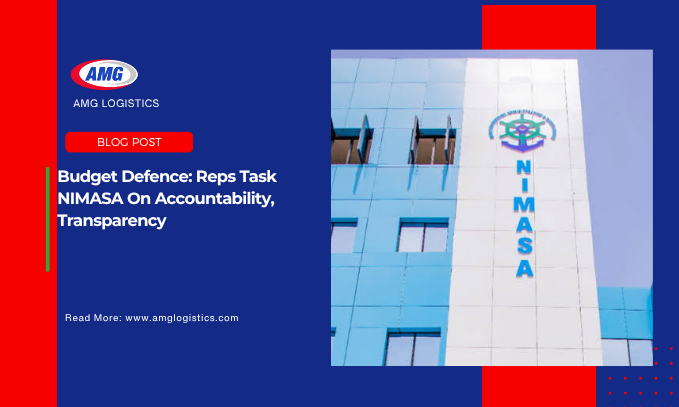
Chairman, House Committee on Maritime Safety, Education and Administration, Khadija Bukar-Ibrahim, has urged Nigerian Maritime Administration and Safety Agency (NIMASA) to ensure transparency, accountability and measurable impact in the implementation of its 2026 budget proposal.
Ibrahim, who gave the charge on Tuesday in Abuja at the 2026 budget defence session with the agency, stressed the need for prudent financial management and alignment with national priorities.
She commended NIMASA for its contributions to maritime safety, security and regulatory oversight, noting that the agency plays a critical role in protecting Nigeria’s territorial waters, facilitating maritime trade and boosting national revenue.
According to her, the budget defence session provides an opportunity for the agency to clearly outline its priorities, strategies and expected outcomes for the 2026 fiscal year.
“As a committee, our responsibility is to ensure that the proposed budget reflects prudent financial management and delivers measurable value to Nigerians,” she said.
The lawmaker said that the committee would pay close attention to key areas, such as maritime insecurity, capacity development and institutional efficiency.
She directed the agency to provide detailed submissions on programmes and projects aimed at strengthening maritime safety and security as well as on plans to improve maritime education and human capacity development.
Ibrahim also called for clear measures to enhance transparency, accountability and revenue generation, alongside updates on ongoing and proposed capital projects and their expected impacts.
She emphasised that the maritime sector remains a vital component of Nigeria’s economic architecture, making it imperative for budgetary allocations to be effectively utilised to achieve sustainable growth and global competitiveness.
The committee chairman further urged the management of NIMASA to be thorough in its presentation and responsive to questions during the exercise.
She assured that the committee would continue to support initiatives aimed at strengthening the maritime sector, while upholding its oversight responsibility in the interest of national development.
In his presentation, the Director-General of NIMASA, Mr Dayo Mobereola, said that the agency had commenced full automation of its operations and revenue collection systems in 2025, following Federal Executive Council’s approval.
According to him, the systems are designed to eliminate leakages and ensure that all revenues due to government are transparently remitted.
On the long-awaited Cabotage Vessel Financing Fund (CVFF), the director-general revealed that the scheme was re-launched in January, and had already attracted about 60 applications from indigenous shipping firms.
He said that a stricter, bank-driven framework had been introduced to prevent the mismanagement that had plagued the fund in the past.
Mobereola explained that under the new structure, financial institutions would assess risks and guarantee repayment before any disbursement to ensure discipline and sustainability.
He said that efforts to empower local ship owners, including access to vessels and critical materials, were ongoing and would gain momentum under the reformed system.