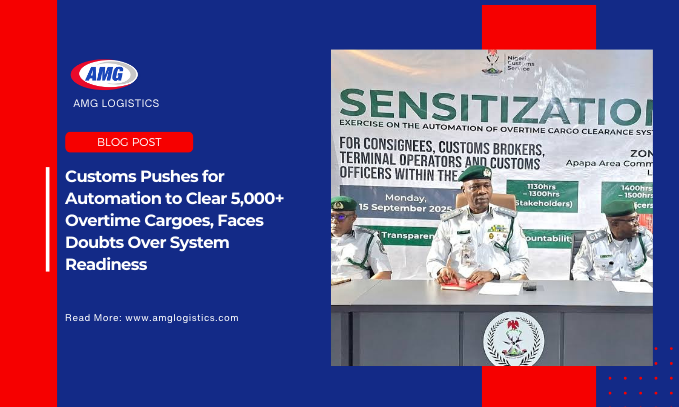
The Nigeria Customs Service (NCS) has reaffirmed its commitment to implementing automation as the only sustainable solution to the growing crisis of overtime cargo congestion at Nigeria’s busiest seaports, including Apapa, Tin Can Island, and Onne.
This follows the revelation by the Comptroller-General of Customs, Bashir Adewale Adeniyi, that more than 50% of complaints he receives daily relate to cargoes left unclaimed or delayed beyond their permitted stay, contributing significantly to port congestion, revenue loss, and inefficiency.
“Some of these disputes end up with the ICPC, EFCC, and even the President’s desk,” Adeniyi said. “One case has dragged for nearly 15 years.”
The Scope of the Problem: Over 5,000 Overtime Cargoes
Investigations by port correspondents indicate that over 5,000 overtime cargoes are currently abandoned or stuck across key ports nationwide. Many of these cargoes remain unaccounted for, with no formal tracking or record, raising concerns about systemic opacity and the potential for mismanagement or corruption.
The Case for Automation
The Customs boss, supported by the NCS National Public Relations Officer, Abdullahi Maiwada, insists that automation of overtime cargo processes is essential to address the problem. He explained that the current manual system makes it almost impossible to obtain accurate data or track the movement and status of overtime cargo.
“If I tell you I can have that data, it will be very difficult through a one-way manual process,” Maiwada said. “That is the reason we are migrating… automation will generate the data in real time.”
Under the proposed automated process, the NCS will implement a tiered timeline for action:
- 30 days: Action from Customs Area Controller
- 60 days: Escalation to Zonal Coordinator
- 90 days: Review by Headquarters
- 120 days: Qualifies for disposal under the Nigeria Customs Service Act, 2023
This would create a structured, transparent process that removes discretion and manual intervention — key concerns that have historically plagued port operations.
System Challenges Threaten Implementation
However, stakeholders remain skeptical about Customs’ readiness to deliver on its automation promise — largely due to the poor performance of its current digital platform, known as B’Odogwu.
Dr. Kayode Farinto, former Acting President of the Association of Nigerian Licensed Customs Agents (ANLCA), warned that the automation project will “flop” unless Customs addresses its ICT infrastructure.
“Our present platform, B’Odogwu, is not seamless. Payments hang, declarations freeze, and cargoes get trapped. Before automating overtime cargo, Customs must first fix the system glitches,” Farinto said.
He also pushed back on claims by the CGC that importers are deliberately abandoning goods, saying such cases are rare and often misunderstood.
“Give us data, give us evidence. Don’t generalise,” Farinto said.
Why This Matters: The High Cost of Delay
The overtime cargo backlog is not just a logistical issue—it has economic, security, and reputational implications. Congested terminals slow down trade, increase demurrage and storage costs, and affect Nigeria’s attractiveness as a regional trade hub.
Port users and logistics experts have long criticized the lack of visibility, recordkeeping, and real-time tracking, which automation is expected to solve — provided the right systems are in place.
Conclusion: Automation Holds Promise, but Risks Remain
The automation of overtime cargo clearance in Nigerian ports could be a game-changer for trade efficiency, transparency, and revenue generation. However, as experts like Dr. Farinto have noted, digital transformation without infrastructure readiness may lead to deeper system failures.
For Customs to succeed, fixing existing platform glitches, investing in robust ICT infrastructure, and engaging stakeholders transparently will be critical. Only then can Nigeria move from manual chaos to automated clarity in managing overtime cargo.