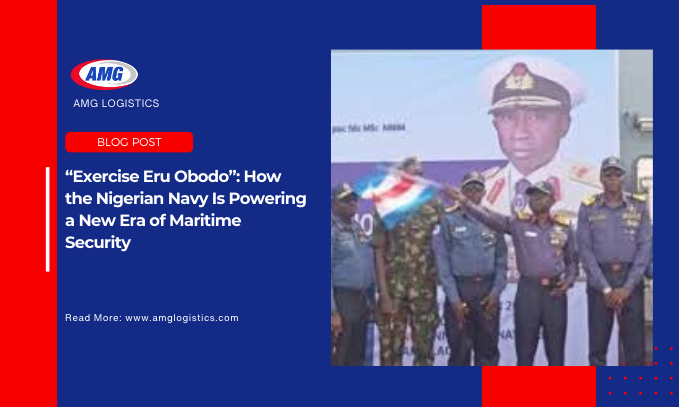
When the Chief of the Naval Staff (CNS), Vice Admiral Idi Abbas, stepped aboard the Nigerian Navy Ship Kada in Lagos to flag off the CNS Annual Sea Inspection (CNSI) 2025, his message to officers was clear and uncompromising:
🔹 This is not just a routine exercise
🔹 It is practical battle training
🔹 And it is critical to Nigeria’s maritime future
The 2025 edition, code-named “Exercise Eru Obodo”—a phrase meaning “guardian of the nation”—couldn’t have been more aptly titled. It represents a renewed commitment by the Navy to defend Nigeria’s vast maritime environment with the highest level of professionalism, precision, and readiness.
Why “Eru Obodo” Matters Now More Than Ever
Nigeria’s maritime space is more than a stretch of blue on the map. It is:
- the highway of international commerce,
- the gateway to immense natural resources, and
- a strategic arena for national security.
From piracy to illegal oil bunkering, from search-and-rescue operations to safeguarding commercial shipping, the challenges at sea are evolving—and so must the Navy’s response.
Vice Adm. Abbas reminded officers that the Nigerian Navy remains “the protector of national economic lifelines and the sentinel against threats emanating from the sea.”
Inside the 2025 Sea Inspection: Training for Real-World Threats
Exercise Eru Obodo has been intentionally designed to mirror the complexities of modern naval warfare. Over the course of the inspection, officers will test and sharpen their capabilities in:
- ✓ Fleet maneuvers
- ✓ Advanced naval gunnery
- ✓ Anti-piracy missions
- ✓ Illegal oil bunkering interdiction
- ✓ Board, search, and seizure operations
- ✓ Long-range logistics and sustainment
- ✓ Search and rescue (SAR) procedures
The CNS challenged officers to push both their platforms and their personal limits, emphasizing that true readiness is measured not in routine conditions but in high-pressure, life-or-death scenarios.
Strengthening Security in the Gulf of Guinea
Beyond national borders, the Nigerian Navy continues to be a stabilizing force across the Gulf of Guinea, a region historically plagued by piracy and maritime crime.
According to the CNS:
“Our efforts have significantly reduced piracy, safeguarded shipping routes, and enhanced governance within the region.”
Exercises like Eru Obodo reinforce Nigeria’s leadership role in safeguarding one of the world’s most important maritime corridors.
Inter-Agency Cooperation: The Future of Maritime Security
The 2025 inspection will also focus on inter-agency synergy—a critical ingredient for modern security operations.
Participants will train alongside key national stakeholders to test coordination, logistics, and combat sustainability far from home bases. This unified approach ensures that threats are tackled not in silos, but as a harmonized national force.
A Vote of Confidence from the Presidency
Vice Adm. Abbas expressed deep appreciation to President Bola Ahmed Tinubu for his unwavering support toward strengthening the Navy’s operational capabilities. Such backing, he noted, has made it possible to expand training, modernize assets, and sustain complex maritime operations.
A Message of Courage and Patriotism
In closing, the CNS delivered a powerful charge to his officers:
“I have no doubt that you will execute your tasks with the courage, skill, and patriotism that define our service.”
Exercise Eru Obodo is more than a drill—it is a declaration of readiness, a testament to national resolve, and a reaffirmation of Nigeria’s commitment to safeguarding its waters and protecting the economic lifelines that keep the country moving.
As the Nigerian Navy sails into the 2025 inspection season, one thing is clear:
a stronger, smarter, and more resilient maritime force is unfolding.
And with operations like Eru Obodo, Nigeria is sending a bold message to the world—
its waters will be protected, its people will be defended, and its maritime future is secure.