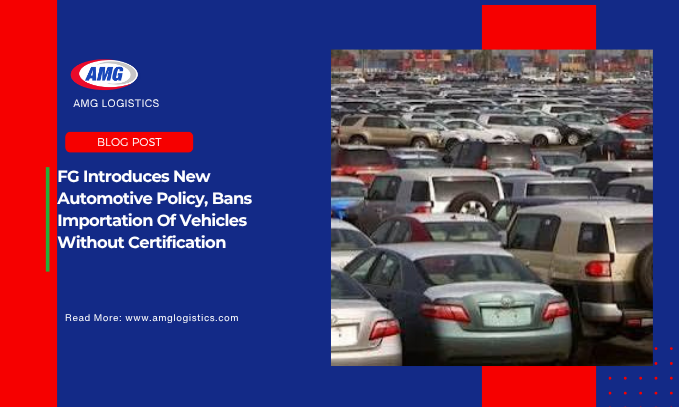
The Federal Government on Tuesday unveiled a sweeping regulatory regime that will ban imported vehicles from entering Nigeria without prior certification.
Government said that the new policy is aimed at improving road safety and curbing the influx of substandard automobiles.
The policy, tagged the Standard Organisation of Nigeria–National Automotive Design and Development Council Vehicle Conformity Assessment Programme (VehCAP),, introduces a strict “no certification, no entry” rule for all new and used vehicles entering the country.
The VehCAP programme builds on the existing SON Conformity Assessment Programme but introduces a sector-specific framework tailored to the complexities of the automotive industry.
Under the new system, vehicles will be assessed and certified in their country of export before shipment to Nigeria.
The policy is expected to improve road safety, reduce environmental risks, protect consumers, and create a more competitive environment for local automotive assembly.
The government maintained that the success of the initiative would depend on strong inter-agency collaboration and strict enforcement, as it seeks to sanitise Nigeria’s vehicle import system and align it with global best practices.
It was inaugurated by the Minister of State for Industry, Sen. John Enoh, who emphasised that vehicle safety and standards were critical to Nigeria’s industrial growth and public protection.

Enoh said the policy required all new and used vehicles to obtain VehCAP certification before import clearance, registration, or licensing.
He stressed that non-compliance would attract seizure and sanctions.
He called for collective action across government agencies, including the Nigerian Customs Service, Central Bank, Federal Road Safety Corps, and state governments, to ensure strict enforcement.
“If we want porous borders, they will be porous; if not, cooperation is essential,” he said.
Enoh said that the initiative not only protected Nigerians from unsafe vehicles but also strengthened industrialisation, consumer confidence, and economic competitiveness.
According to him, under the new regime, all vehicles must obtain pre-shipment certification before they can be processed for importation into Nigeria.
“So the endorsement integrates vehicle safety into Nigeria’s economic policy framework. It aligns fiscal instruments, foreign exchange import financing, and revenue systems with safety and standards objectives. It also strengthens the long-standing work of the Standard Organisation of Nigeria and NADDC within a coordinated whole-of-government approach. And I think that with effect from the commencement of this SON-NADDC VehCAP, all new and used vehicles and automotive products entering Nigeria must obtain pre-shipment certification on that VehCAP before form M approval, before customs valuation, before power processing, before import clearance, and before market entry,” he stated.
Enoh stressed that any vehicle that fails to meet the requirements would be denied entry into the country.
“No vehicle or automotive product shall be imported, cleared, registered or licensed without valid certification. Any non-compliant import shall be subject to refusal of clearance, seizure, or sanctions under applicable laws,” he added.
The minister, however, acknowledged concerns around calls to ban used vehicles, popularly known as “Tokunbo,” urging a balanced approach.
“I think that without taking an extreme position, we must find a middle ground. There are economic challenges, there is purchasing power, and there is also the capacity of local assemblers to meet demand.
The Director-General, Standards Organisation of Nigeria (SON), Dr Ifeanyi Okeke, said the initiative represented a shift to a preventive, standards-driven system that ensured only compliant vehicles entered the Nigerian market.
According to Okeke, substandard automotive products pose risks to road safety, consumer protection and public confidence, stressing the need for stronger regulatory oversight.
He said VehCAP, developed in collaboration with National Automotive Design and Development Council (NADDC), would enhance coordination, promote transparency and align Nigeria’s automotive standards with global best practices.
Also speaking, the Director-General of NADDC, Mr Joseph Osanipin, said the programme introduced a sector-specific framework to verify vehicle safety, emissions and structural integrity before shipment.
Osanipin said many imported vehicles entered the country without proper checks, contributing to accidents, environmental concerns and unfair competition for local manufacturers.
He added that VehCAP would shift regulation from post-arrival inspection to pre-entry verification, reducing risks and strengthening enforcement efficiency.
The various stakeholders at the event emphasised the need for collaboration among ministries, departments and agencies to ensure effective implementation and achieve improved safety outcomes