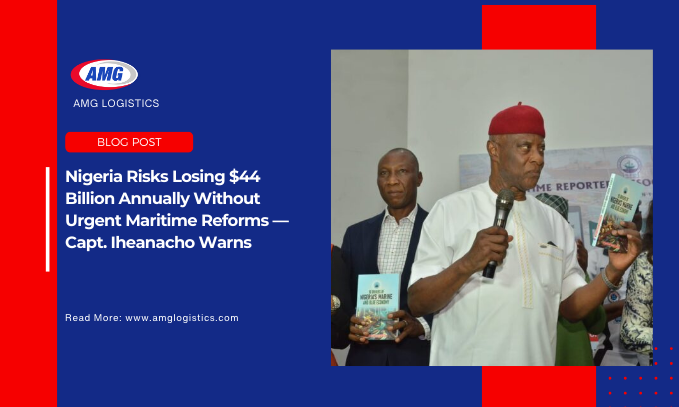
Nigeria could forfeit up to $44 billion (₦70 trillion) in yearly economic value if it fails to urgently reform its maritime and blue economy sector, renowned maritime expert and former Minister of Interior, Capt. Emmanuel Iheanacho, has warned.
Speaking in Lagos at the public presentation of the Maritime Reporters Association of Nigeria (MARAN)’s new publication, “Fifty Drivers of the Nigerian Maritime and Blue Economy,” Iheanacho said Nigeria’s vast coastal and maritime resources remain dangerously underutilized despite recent policy advancements.
A Country Sitting on Untapped Maritime Wealth
With 853 kilometres of coastline and expansive inland waterways, Nigeria possesses one of Africa’s richest maritime endowments.
But according to Iheanacho, the country’s inability to modernize its ports, implement policies rigorously, and strengthen governance continues to drain billions in potential revenue every year.
“Nigeria today has a strong blueprint with clear economic opportunities. But unless we address infrastructure gaps, improve governance, mobilise private capital and strengthen port efficiency, the country will continue to underperform,” he said.
The New National Marine and Blue Economy Policy: A Breakthrough at Risk
Earlier this year, the Federal Government approved the National Marine and Blue Economy Policy (2025–2034) — a milestone roadmap for:
- Maritime trade expansion
- Aquaculture and fisheries development
- Blue tourism
- Clean ocean energy
- Coastal and marine ecosystem management
Iheanacho applauded the policy as a significant breakthrough, but warned that without decisive implementation, infrastructure renewal, and institutional discipline, it risks becoming yet another ambitious document with little real-world impact.
$44 Billion in Potential, But a System Not Built to Harness It
Iheanacho argued that the maritime sector’s potential is not theoretical but proven. With the right reforms, the blue economy could:
- ✔ Add $44 billion to Nigeria’s GDP annually
- ✔ Expand foreign exchange earnings
- ✔ Create hundreds of thousands of jobs
- ✔ Position Nigeria as a dominant maritime power in Africa
However, Nigeria’s current maritime system, he stressed, is not structurally equipped to unlock this wealth.
Aging Ports, Weak Intermodal Links, and Slow Reform
Iheanacho identified slow and inconsistent policy execution as the sector’s biggest weakness.
Many of Nigeria’s ports—especially Apapa and Tin Can Island—are outdated, overstretched, and lagging far behind regional competitors such as Tema in Ghana and Lomé in Togo.
Additional structural problems include:
- Excessive reliance on road transport
- Insufficient private-sector participation
- Uncompetitive cargo clearance processes
- Weak intermodal systems
- Costly operational delays that erode investor confidence
Even recent improvements—such as a 75% performance score by the Ministry of Marine and Blue Economy and zero piracy incidents in key shipping corridors—cannot mask the deep systemic challenges holding the sector back.
Private Sector Participation: The Missing Ingredient
The former minister emphasized that the government cannot single-handedly build a globally competitive maritime sector.
“Without private capital and expertise, we cannot modernise our ports, expand ship-owning capacity, or build a competitive blue economy,” he said.
Public–Private Partnerships (PPPs), he argued, are essential to:
- Finance port modernization
- Expand national fleet capacity
- Build efficient coastal logistics
- Develop maritime infrastructure at scale
Nigeria at a Crossroads
Iheanacho cautioned that Nigeria faces a defining moment:
- ➤ Either implement reforms now and unlock its maritime wealth
- ➤ Or watch its blue economy potential continue to slip away
The event’s attendees—including top maritime stakeholders and analysts—echoed his position. With the right political will, policy consistency, and aggressive infrastructure renewal, Nigeria could transform the maritime sector into a trillion-naira economic engine.
But without immediate action, they warned, Africa’s largest economy risks remaining stuck in a cycle of missed opportunities, outdated systems, and declining competitiveness.