
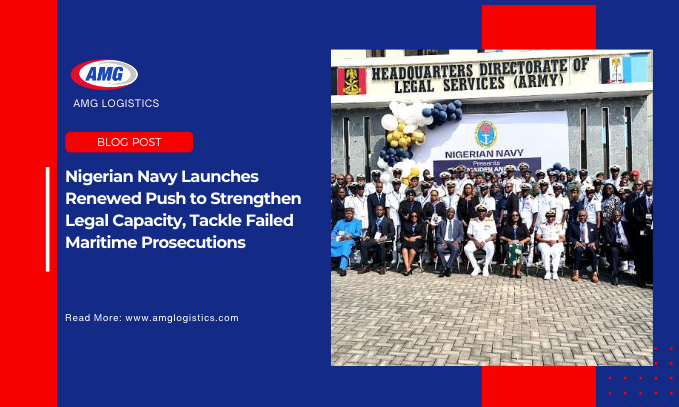
The Nigerian Navy has begun a strategic overhaul of its legal framework in response to rising concerns over failed maritime prosecutions, procedural gaps, and the growing complexity of law enforcement across Nigeria’s territorial waters.
This renewed effort was announced by the Chief of Administration (Navy), Rear Adm. Jonathan Mamman, during the opening ceremony of the Navy’s maiden Legal Training Seminar on Tuesday in Abuja.
Legal Weaknesses Now a National Security Threat, Navy Warns
Rear Adm. Mamman emphasized that persistent legal weaknesses have created a dangerous security gap—one that maritime criminals continue to exploit through loopholes, poor documentation, mishandled evidence, and fragmented inter-agency coordination.
He warned that despite operational successes at sea, many cases continue to collapse in court due to preventable technical errors.
“It is no longer enough to intercept vessels or arrest suspects at sea. If the cases fall apart before a judge, our operational successes become meaningless,” Mamman stated.
Seminar Focus: Strengthening Prosecution and Justice Delivery
The three-day seminar, themed “Strategic Enforcement of Maritime and Labour Law for Enhanced Naval Operations and Justice Delivery in Nigeria,” aims to equip naval legal officers with the skills needed to:
- effectively prosecute maritime crimes
- strengthen vessel arrest and detention procedures
- handle evidence professionally
- align investigations with national and international law
- improve coordination with partner agencies
Rear Adm. Mamman identified four core problem areas:
- Weak prosecution of maritime offences due to documentation lapses and mishandled evidence
- Procedural inconsistencies within Standing Courts Martial
- Labour and personnel-related disputes affecting welfare and rights
- Increasing intersections between civil–military relations, human rights, and international law
He noted that Nigeria’s maritime environment has evolved, requiring legal officers who can match operational achievements with airtight courtroom strategy.
Tri-Service Support for Legal Reforms
The seminar is being hosted at a Nigerian Army facility, a decision Mamman said highlights the growing tri-service approach to justice delivery across the Armed Forces.
He stressed that legal failures in one branch of the military weaken the effectiveness of the entire defence architecture.
Rear Adm. Mamman commended the Chief of Naval Staff, Vice Adm. Idi Abbas, for championing legal reforms and supporting efforts to enhance professionalism within the Navy’s legal corps.
Defence Ministry Praises Navy’s Commitment to Rule of Law
The Minister of State for Defence, Bello Matawalle, represented by the Director of Legal Services, Mr. Usman Muhammed, applauded the Nigerian Navy for prioritizing legal excellence and reinforcing adherence to the rule of law.
Matawalle stated that the Navy plays a critical role in safeguarding Nigeria’s territorial and economic interests—making it essential for personnel to operate with a clear and thorough understanding of laws governing both land and maritime operations.
“Your contribution will undoubtedly strengthen the Nigerian Navy’s capabilities and reinforce its position as a respected institution in our nation’s defence architecture,” he said.
Strengthening Maritime Justice for National Security
As maritime threats evolve—from illegal oil bunkering and piracy to smuggling and unlicensed vessel operations—the Nigerian Navy’s renewed focus on legal capacity marks a critical step toward improving justice delivery and ensuring that operational successes translate into convictions.
The seminar is expected to produce actionable reforms that will reinforce Nigeria’s maritime security, enhance inter-agency cooperation, and strengthen the legal foundations of naval operations.