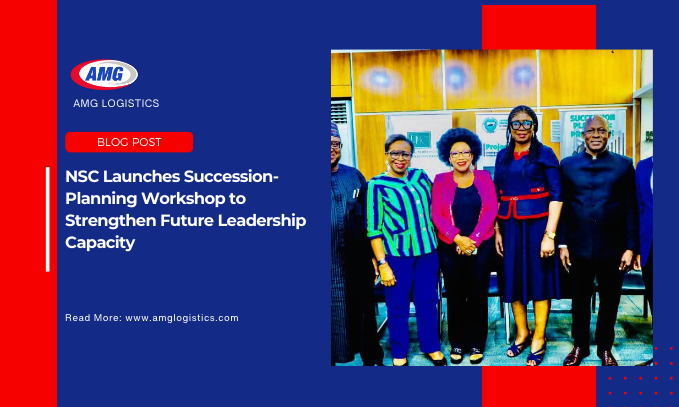
The Nigerian Shippers’ Council (NSC) has taken a major step toward ensuring long-term leadership stability with the launch of a comprehensive succession-planning workshop for middle-level managers.
The initiative, held in Lagos, marks a critical shift toward proactive leadership grooming as the Council prepares for increasing retirements and rising regulatory demands in Nigeria’s maritime and logistics ecosystem.
Why the NSC is Prioritising Succession Planning
In recent years, the maritime sector has undergone major transformation—from digital integration to expanded regulatory responsibilities. With a significant number of senior officers approaching retirement, the NSC faces a growing leadership gap that could impact institutional efficiency if not properly addressed.
The newly launched succession-planning programme is designed to prevent such disruption by identifying and preparing competent leaders early.
“We Must Intentionally Prepare Future Leaders” — Ify Okolue
Speaking on behalf of the Executive Secretary/CEO, Dr. Akutah Pius, MON, the Director of the Consumer Affairs Department, Mrs. Ify Okolue, emphasised that the era of informal leadership grooming is over.
“Our goal is to raise competent, confident and future-ready leaders who can drive the Council’s mandate in the coming years,” she stated.
She highlighted the need for a structured and merit-based system that not only identifies emerging talent but also equips them with the skills needed for higher responsibilities.
According to Okolue, the future of the Council depends on how effectively it can build a pipeline of visionary leaders who understand both the complexity and the economic significance of Nigeria’s maritime industry.
A Strategic Response to Operational Realities — HR Director
The Director of Human Resources Management, Mustapha Zubairu, described the succession-planning workshop as a strategic move designed to safeguard institutional continuity.
He noted that as senior officers exit the system, there is a risk of losing critical institutional knowledge—unless the Council invests in structured leadership development.
“This workshop is not just a training programme; it is a deliberate strategy to preserve institutional memory and prepare capable leaders who will sustain NSC’s operations,” Zubairu said.
He reiterated that the Council must remain ahead of industry evolution, especially as maritime regulation becomes more technology-driven and globally competitive.
Building a Future-Ready Maritime Regulator
The NSC’s succession-planning workshop aims to:
- Identify high-potential employees at mid-management level
- Build leadership competencies aligned with the Council’s long-term goals
- Strengthen institutional capacity and continuity
- Preserve institutional knowledge amid rising retirements
- Position NSC as a modern, future-ready economic regulator
This approach is in line with global best practices where regulatory agencies invest heavily in leadership pipeline development to ensure consistent service delivery.
Why Succession Planning Matters Now More Than Ever
With maritime trade expanding, port digitalisation accelerating, and Nigeria’s blue economy receiving new policy attention, the NSC plays an increasingly critical role in economic regulation.
Its ability to enforce standards, protect shippers, improve port competitiveness, and spearhead reforms depends on having experienced and capable leadership at all levels.
Succession planning ensures that:
- Leadership transitions happen seamlessly
- Institutional memory is preserved
- Service delivery remains uninterrupted
- The Council remains competitive and resilient
Conclusion
The Nigerian Shippers’ Council’s decision to launch a targeted succession-planning workshop demonstrates foresight and commitment to sustainable leadership development.
By intentionally preparing the next generation of managers, the Council is securing its institutional future and strengthening its capacity to deliver on its mandate in a rapidly evolving maritime environment.
This initiative positions NSC as a forward-thinking regulator—one that understands that leadership continuity is essential for national economic competitiveness.