The Nigerian Shippers’ Council (NSC) has raised alarm over persistent police interference in cargo clearance processes at Nigeria’s seaports, warning that the practice continues to inflate logistics costs, delay cargo evacuation, and undermine port efficiency.
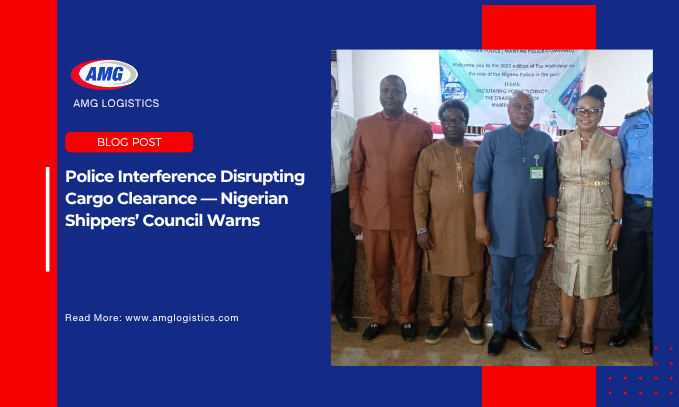
The Executive Secretary of the NSC, Dr. Pius Akutah, made this known in Lagos during a one-day training programme for officers of the Maritime Police Command and other security stakeholders. The training, themed “Facilitating Port Efficiency: The Strategic Role of the Police,” was organised to foster synergy between maritime regulators and law enforcement agencies.
Police Interference Increasing Demurrage, Storage Charges
Represented by the Director, Regulatory Services Department, Mrs. Margaret Ogbonnah, Akutah revealed that the Council has received multiple stakeholder reports alleging undue interference by police officers in cargo clearance activities.
According to him, these disruptions include:
- Placement of unauthorised detention orders on duly cleared cargo
- Intimidation of shipping line staff and terminal operators
- Delays leading to increased demurrage and storage charges
- Escalation of business costs in Nigerian ports
Akutah noted that although officers often claim to act on intelligence reports, NSC investigations have confirmed several cases of intimidation and irregular intervention, often carried out by police formations without the knowledge or approval of the Assistant Inspector General of Police (AIG).
NSC and IGP Move to Curb Unauthorized Police Actions at Ports
In response to the recurring infractions, the NSC engaged the Inspector General of Police (IGP) to streamline processes and curb unauthorized actions.
Key outcomes of the engagement include:
- A December 11, 2018 directive mandating stakeholders to disregard any police correspondence not signed by the AIG or an authorized representative
- Internal measures by Maritime Police Command to stop the issuance of letters by unauthorized personnel
- Renewed commitment to ensuring transparency and adherence to international best practices
Akutah emphasized that while progress has been made, isolated infractions persist, either due to negligence or inadequate knowledge of port operations. This underscores the need for continuous capacity building — the focus of the day’s training.
Maritime Police Reaffirm Commitment to Securing Nigeria’s Ports
Addressing participants, the Assistant Inspector General of Police, Chinedu Oko, represented by ACP Olufikayo Fawole, described the Maritime Police as a specialized unit critical to safeguarding Nigeria’s maritime economy.
She highlighted the unit’s responsibilities, including:
- Securing maritime assets
- Preventing cargo-related crimes
- Combating pilferage, vandalism, and illegal interference
- Supporting seamless and legitimate trade
Fawole emphasized that port security now demands smarter, technologically equipped, and better-trained officers, owing to evolving criminal trends and increasingly complex logistics chains.
“Our mandate is not just to enforce the law but to protect the economic lifeblood of our nation,” she said.
The AIG pledged the Police Force’s continued commitment to a secure, predictable port environment — a key factor in improving Nigeria’s global trade competitiveness.
Driving Toward a More Efficient, Globally Competitive Port System
The collaboration between the NSC and the Maritime Police marks another step in tackling bottlenecks in the Nigerian port ecosystem. By enhancing awareness, enforcing proper procedures, and eliminating unauthorized interference, both institutions aim to reduce cost-inducing delays and boost overall port performance.
With cargo throughput rising and international trade requirements evolving rapidly, stakeholders agree that effective law enforcement, guided by the right training and clear protocols, remains vital to Nigeria’s economic prosperity.