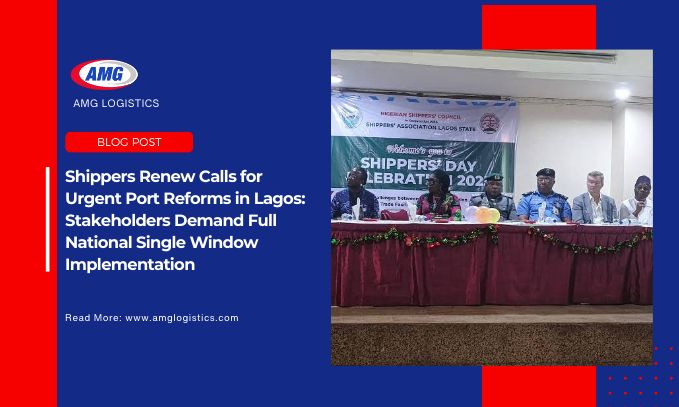
Nigeria’s maritime sector is once again in the spotlight as shippers in Lagos State issued strong demands for an urgent overhaul of the country’s port operations. Speaking at the 2025 Shippers’ Day Celebration, organised by the Shippers Association Lagos State (SALS) in collaboration with the Nigerian Shippers’ Council (NSC), stakeholders highlighted persistent challenges crippling trade efficiency and weakening Nigeria’s competitiveness as a regional maritime hub.
A Port System That Punishes Compliance
SALS President Nicodemus Odolo painted a troubling picture of Nigeria’s current port environment—one marked by multiple levies, arbitrary charges, illegal checkpoints, prolonged delays, and bureaucratic bottlenecks that continue to inflate logistics costs.
According to Odolo, compliant shippers often face the worst delays because they refuse to “cut corners,” with some containers remaining in the ports for months. Meanwhile, those who engage in rent-seeking practices enjoy swift clearance.
“Whoever wants to do things right in Nigeria suffers,” Odolo lamented, calling for transparency, fairness, and the dismantling of systems that reward corruption.
He further accused certain security agencies—especially the police—of overstepping their mandate by stopping export containers on highways under the guise of verifying customs duty.
Nigerian Shippers’ Council Responds: Reforms on the Horizon
In response, NSC Executive Secretary Dr. Pius Akutah acknowledged the destructive impact of arbitrary taxes and overlapping charges across the logistics chain. He emphasized the Council’s commitment to harmonising fiscal policies and ensuring that port operations genuinely support trade facilitation.
A major highlight of his remarks was his strong support for the National Single Window, a comprehensive digital platform designed to integrate all port processes, eliminate duplicated documentation, reduce clearance delays, and enhance trade efficiency.
Akutah also addressed complaints over the 4% FOB tax imposed by the Nigeria Customs Service (NCS), assuring that discussions are ongoing to align fiscal measures with Nigeria’s economic priorities.
Customs Highlights Modernisation Agenda
Representing the Comptroller-General of Customs Bashir Adeniyi, ACG Muhammed Babadede described the indigenous B’Odogwu Unified Customs Management System as a powerful tool for digitising cargo clearance.
He stated that B’Odogwu:
- Reduces human interface
- Minimises errors
- Provides real-time visibility for stakeholders
Additional initiatives such as the Advance Ruling System, Time Release Study, Authorised Economic Operator (AEO) programme, and a One-Stop Shop mechanism are expected to significantly reduce clearance times.
Adeniyi confirmed that the National Single Window and B’Odogwu platforms will be fully integrated by Q1 2026, creating a unified digital trade ecosystem aligned with global best practices.
Industry Experts Call for Structural Reforms
Maritime lawyer Osuala Nwagbara argued that persistent excessive charges reveal deeper structural weaknesses in Nigeria’s maritime industry. He described the growing advocacy by shippers as a sign that arbitrary practices will no longer be tolerated.
The President of the Barge Owners Association and Exporters (BOAEX), Mr. Bunmi Olumekun, urged importers and exporters to remain committed to national development, noting the crucial role trade plays in sustaining Nigeria’s economy.
Similarly, CRFFN Registrar Kingsley Igwe, represented by Mr. Ben Ojuma, called for government incentives that would enable shippers to acquire larger vessels, enhancing Nigeria’s trade competitiveness.
A Warning for Nigeria’s Maritime Future
Stakeholders concluded with a strong message: without immediate reforms—especially the implementation of the National Single Window, removal of arbitrary port charges, and elimination of illegal checkpoints—more shippers will abandon the industry, and Nigeria risks losing even more cargo traffic to neighbouring West African ports.
The demands are not merely about convenience; they are critical to:
- business survival
- trade competitiveness
- national economic growth
The maritime sector is the lifeline of Nigeria’s import-dependent economy, and stakeholders insist that genuine reforms cannot be delayed any further.