
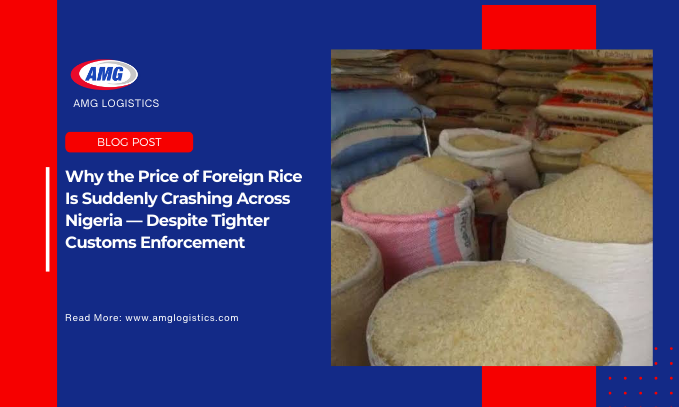
Nigeria is experiencing an unexpected and dramatic drop in the price of foreign parboiled rice—at a time when the Nigeria Customs Service (NCS) has intensified border security operations ahead of the festive season.
Findings by Shipping Position Daily show that a 50kg bag of foreign rice, which sold for ₦90,000–₦100,000 in December 2024, now goes for ₦55,000–₦70,000 nationwide. In some border communities, prices have plunged to ₦49,000–₦50,000—a level that has surprised both traders and enforcement officers.
The sharp decline has sparked conversations across markets and border corridors, raising one big question:
👉 How is rice becoming cheaper while enforcement is getting tougher?
Conflicting Trends: Stronger Enforcement, Cheaper Rice
According to stakeholders, the price crash is unusual for this time of year—especially with Customs deploying new layers of technology and surveillance to combat smuggling.
Former Chairman of ANLCA (Seme Chapter), Onyekachi Ojinma, explained the puzzle clearly:
“In Imo State today, foreign rice is ₦50,000–₦55,000. In Lagos, it goes for ₦60,000–₦62,000. But at the Seme border, enforcement is extremely tight. Not even a cup of rice passes through officially.”
While small-scale re-bagging takes place in areas like Badagry and Okokomaiko, Ojinma believes this alone cannot account for the nationwide price collapse.
He suggests that alternative supply routes—especially the Kano–Niger corridor—may now be shaping market dynamics.
“Rice Still Finds Its Way In” — Traders Speak
In Badagry, trader Senayon Ajose confirmed that Customs enforcement has increased significantly, especially after recent high-profile interceptions. But she also acknowledged that:
“The product still finds its way into markets, which is why prices in Badagry are now around ₦49,000–₦50,000.”
Her comment reflects the long-standing reality that border tightening often shifts, rather than eliminates, smuggling patterns—as traders search for new routes and loopholes.
Customs: Enforcement Is Now Smarter, Not Just Tougher
The Nigeria Customs Service maintains that the current crackdown is powered by intelligence, data, and technology, not brute force.
NCS National PRO, Abdullahi Maiwada, highlighted the Service’s upgraded enforcement tools:
- Geospatial intelligence
- Satellite tracking systems
- Real-time analytics
- Targeted patrols based on risk profiling
According to him, these modern tools allow Customs to intercept suspicious activity without disrupting legitimate trade.
“Not every strategy can be openly discussed, but our operations are now more precise and intelligence-driven,” Maiwada said.
He added that Federal Operations Units across the country have been reinforced to counter the typical spike in smuggling attempts during the festive season.
So What’s Driving the Falling Prices?
Industry watchers point to a combination of factors:
- ✔ Alternative supply routes quietly expanding
- ✔ Increased local market competition
- ✔ Stockpiles entering the market ahead of the holidays
- ✔ Traders adjusting prices to stimulate demand during tough economic times
But with enforcement tightening and the yuletide rush approaching, the market fundamentals may shift again—keeping traders, consumers, and regulators on alert.
Consumers Are Happy—But Analysts Want Answers
For millions of households, the lower prices are a welcome relief during a difficult economic year.
But analysts warn that the opaque nature of the supply chain makes it difficult to determine how long the current trend will last.
With the festive season in full swing, all eyes remain on:
- Border movements
- Customs operations
- Market behavior across major trading hubs
And as December progresses, the big question lingers:
Will rice prices remain low—or is this a temporary dip before another surge?