As the global community marks World Maritime Day 2025 under the theme “Our Ocean, Our Obligation, Our Opportunity,” Nigeria faces a sobering truth: despite its vast maritime endowment, it continues to underperform in unlocking the economic, environmental, and strategic potential of its waters.
From shipping and trade to fisheries, tourism, and energy, the blue economy presents Nigeria with a generational opportunity. But weak governance, policy inconsistency, institutional rivalry, and environmental neglect continue to define the narrative. These are Nigeria’s blue economy challenges—and they must be urgently addressed.
A Maritime Nation With Untapped Potential
Nigeria is not landlocked. With over 853 km of coastline and an Exclusive Economic Zone (EEZ) extending over 200 nautical miles, the country is strategically positioned to become a leading maritime hub in Africa.
However, for decades, mismanagement and short-sightedness have left this sector largely dormant. Unlike other African countries such as Ghana and Mauritius, Nigeria has failed to transform its maritime potential into economic growth and sustainable development.
The Ministry of Marine and Blue Economy: A Vision Yet to Be Realize
The creation of the Ministry of Marine and Blue Economy in 2023 by President Bola Ahmed Tinubu was seen as a milestone. The ministry was tasked with:
- Unifying maritime governance
- Attracting investment
- Modernizing ports
- Protecting marine ecosystems
Yet, nearly two years later, little structural progress has been made. Nigeria still lacks a comprehensive National Blue Economy Policy, and the sector operates without clear timelines, targets, or measurable outcomes.
Port Inefficiency: The Bottleneck That Won’t Go Away
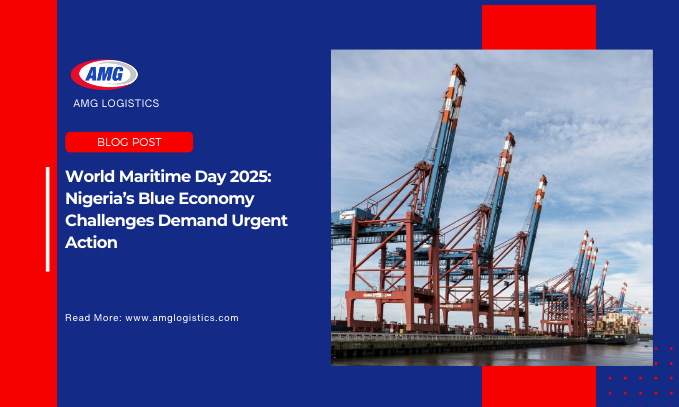
One of Nigeria’s most visible blue economy challenges is its notoriously inefficient ports. Compared to regional competitors like the Port of Tema in Ghana, Nigeria’s ports in Apapa, Tin Can, and Port Harcourt remain plagued by:
- Congestion
- Poor automation
- Corruption
- Bureaucratic delays
- High charges
These issues push shipping lines and traders to redirect cargo to Cotonou and Lomé, draining Nigeria of both revenue and relevance.
Environmental Neglect: A Crisis in the Making
While the theme of this year’s World Maritime Day emphasizes obligation, Nigeria’s environmental performance shows the opposite.
- Oil spills continue to ravage the Niger Delta, killing marine life and livelihoods.
- Plastic waste clogs inland waterways and coastal zones.
- Coastal erosion is displacing entire communities in Bayelsa, Rivers, Delta, and Lagos.
Yet, marine environmental protection remains sidelined in national policy discussions.
Institutional Rivalry: Too Many Cooks, Not Enough Results
Another major hurdle in tackling Nigeria’s blue economy challenges is the lack of inter-agency coordination. Key agencies—NIMASA, NIWA, NPA, and others—operate in silos, often duplicating efforts and engaging in turf wars.
Without a single-window system or a law-backed maritime governance framework, efficiency is compromised, investors are frustrated, and progress remains elusive.
Lessons from Other Nations
While Nigeria sleeps on its maritime potential:
- Singapore became a global shipping hub without oil wealth.
- Dubai used maritime trade to diversify away from fossil fuels.
- Mauritius built a sustainable blue economy anchored on fisheries, tourism, and innovation.
These countries understood that vision, discipline, and investment—not just geography—create economic success.
What Needs to Change: A Call to Action
To overcome Nigeria’s blue economy challenges, the following actions are imperative:
1. Develop a National Blue Economy Policy
- Include timelines, metrics, and budgetary commitments.
- Integrate sectors: shipping, fisheries, tourism, energy, and environment.
2. Modernize Port Infrastructure
- Implement full automation and port community systems.
- Reduce clearance times and port charges.
- Streamline regulatory processes.
3. End Agency Fragmentation
- Create a law-backed single-window platform.
- Define roles and eliminate overlapping mandates.
- Prioritize collaboration over competition.
4. Strengthen Maritime Security
- Sustain and fund the Deep Blue Project.
- Coordinate NIMASA, Nigerian Navy, and Marine Police operations.
- Combat piracy, oil theft, and illicit trade.
5. Invest in Environmental Protection
- Enforce oil spill regulations.
- Launch marine debris and plastic waste removal campaigns.
- Address coastal erosion through science-based engineering.
6. Build Human Capital
- Establish training academies in marine engineering, maritime law, fisheries management, and port logistics.
- Offer incentives for innovation in blue tech and marine sustainability.
Conclusion: Wake Up Before It’s Too Late
This year’s World Maritime Day theme—“Our Ocean, Our Obligation, Our Opportunity”—is more than a slogan. For Nigeria, it’s a warning.
The ocean is not a dumping ground or an afterthought; it is the lifeline of future prosperity. Failure to act decisively now means losing ground not only to regional peers but also to future generations who will inherit a degraded, underutilized maritime domain.
Nigeria’s blue economy can be a national asset or a missed opportunity. The choice is still ours—but not for long.